
If you’re living with facial palsy, you’ve probably spent more time analyzing your face than most people ever will. You are intimately acquainted with even the most subtle differences between one side of your face and the other. And once you’re aware of them, they can be difficult to ignore, taking a toll on your emotional well-being and self-confidence.
The reality is that facial palsy can affect facial appearance and movement in ways that may be noticeable to others. Fortunately, there are a number of simple strategies that can help create greater visual balance and influence how facial asymmetry is perceived.
False Eyelashes: Support for Blinking
False eyelashes may be one of the more unexpected tools in the facial palsy toolbox. When facial palsy affects the muscle around the eye responsible for blinking and eyelid closure, even a small amount of additional weight on the upper eyelid can be helpful. False eyelashes, particularly the heavier varieties, work with gravity to help the eyelid lower more easily during blinking and closing. The concept is similar to external eyelid loading, a technique that uses small weights attached to the upper eyelid to promote more complete eyelid closure.
Facial Hair: Framing the Lower Face
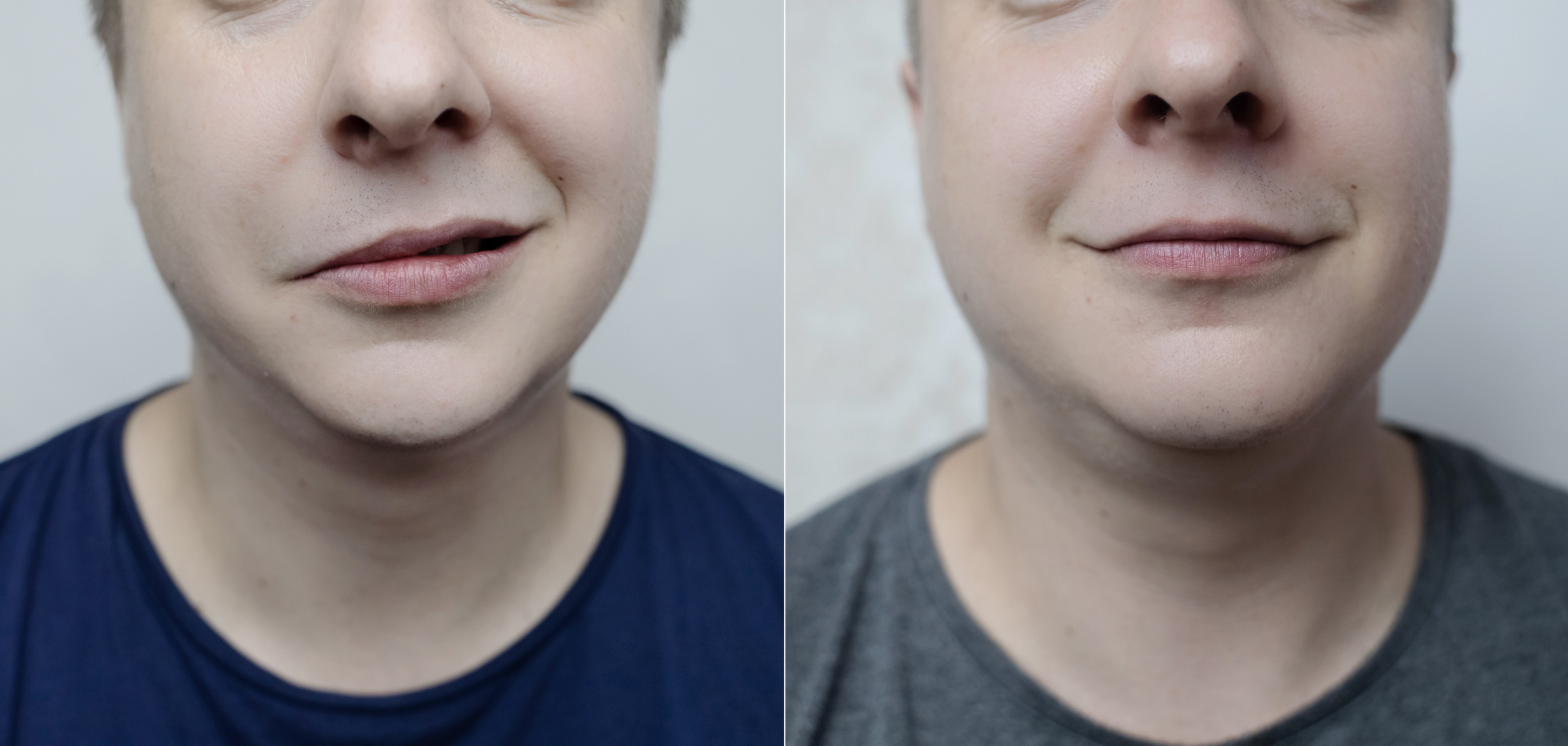
Facial hair can be a simple and effective way to create greater visual balance. Beards and mustaches can help soften asymmetry in the lower face by disguising differences in facial contours, volume, and the position of the mouth. In some cases, allowing the beard to grow slightly fuller on the affected side can further reduce the appearance of asymmetry by adding visual fullness where it may be lacking. That said, facial hair won’t be the right solution for everyone. Its ability to disguise asymmetry is often greatest when the face is relaxed, and some people with longstanding facial palsy may experience uneven facial hair growth, limiting its usefulness.
Makeup Therapy: Enhancing Facial Balance
Makeup may seem like an obvious addition to this list, and for good reason: it remains one of the most adaptable tools for people with facial palsy. With makeup therapy, subtle adjustments can make a meaningful difference. For example, contouring the unaffected side of the face can help reduce the appearance of fullness, while highlighting the affected side can create the impression of additional volume. Brows also play an important role in facial symmetry, and carefully shaping or filling the eyebrow on the affected side can help create greater balance. Likewise, lip liner can be used to redefine the lips and improve symmetry around the mouth.
Eyewear: Redirecting Focus
Like false eyelashes, eyewear can serve both a practical and cosmetic purpose. In addition to helping protect the eyes from dryness and irritation, glasses can help soften asymmetry around the eyes and brows. Larger or thicker frames can draw attention away from differences in eye opening or eyebrow position, while tinted lenses may help conceal incomplete eyelid closure. For individuals who struggle with fit due to facial asymmetry, custom or specialty frames may also be worth considering.
Hairstyle Modifications: Softening Facial Asymmetry
If you’ve ever grown out your bangs, changed your part, or tried a completely new hairstyle, you know how much of an impact hair can have on your overall appearance. Longer hair or side-swept bangs on the affected side can be an easy way to soften eyebrow drooping, forehead asymmetry, and changes around the eye. And because hair naturally frames the face, even relatively small styling changes can influence what people notice first. Asymmetrical hairstyles, in particular, can help draw attention toward the unaffected side of the face and create greater visual balance.
Photograph: Tips for More Balanced Photos
For many people with facial palsy, few things can trigger self-consciousness quite like taking a picture. Unlike a conversation, where expression, movement, and personality are constantly in motion, a photograph captures only a single moment, and that moment can sometimes seem to exaggerate asymmetry. For this reason, many people with facial palsy prefer not to face the camera completely straight on. A slight turn of the head, particularly one that places the unaffected side more prominently, can help reduce the visual contrast between the two sides of the face. Because every face is different, some experimentation is often required to determine which angles feel most natural and flattering.
Smiling is often the expression people with facial palsy worry about most, particularly when it comes to photographs. However, research suggests that smiling may not affect how others perceive attractiveness in people with facial palsy as much as they might fear.1 For some, a gentle, closed-mouth smile can offer a comfortable middle ground, conveying warmth while minimizing asymmetry around the mouth.
Beyond camera angle and expression, a few other tricks can help. Sunglasses can serve a dual purpose by protecting the eyes and helping to disguise differences around the eyes and brows. Lighting can also make a big difference. Positioning the light source on the unaffected side often creates softer shadows on the affected side, resulting in a more balanced appearance. Finally, it helps to remember that cameras and mirrors are not telling the same story. Most selfie cameras display a mirrored version of our face, while photographs typically show us a non-mirrored image. As a result, photos can sometimes feel unfamiliar, more asymmetrical, or simply different from what you are accustomed to seeing in the mirror.
Putting It All Together
While these techniques can help create greater visual balance, they are just one piece of the puzzle. Many people with facial palsy benefit from a combination of approaches, which may include physical therapy, Botox, surgery, or other treatments. The goal is finding the combination of tools and therapies that works best for you. If a particular strategy helps you feel more comfortable in front of a camera, in a social setting, or simply when looking in the mirror, that’s reason enough to consider it.
- Ishii L et al. Laryngoscope. 2012; 122(3):533-8.