
What to Expect: Recovery Timeline
When will I start to see improvement?
Most patients with Bell's palsy begin to see some improvement within 2-3 weeks after symptoms start. Complete recovery typically occurs within 3-4 months.
What are my chances of full recovery?
Ramsay Hunt syndrome recovery:
If your facial palsy is caused by Ramsay Hunt syndrome (the shingles virus), recovery tends to take longer and may be less complete than Bell's palsy. However, when antiviral treatment is started within 72 hours, over 80% of patients recover completely or with only minor lasting effects.
What is synkinesis?
About 1 in 4 patients may develop synkinesis—involuntary movements that happen when you try to move your face. For example, your eye might blink when you smile. Physical therapy can help prevent and treat this.
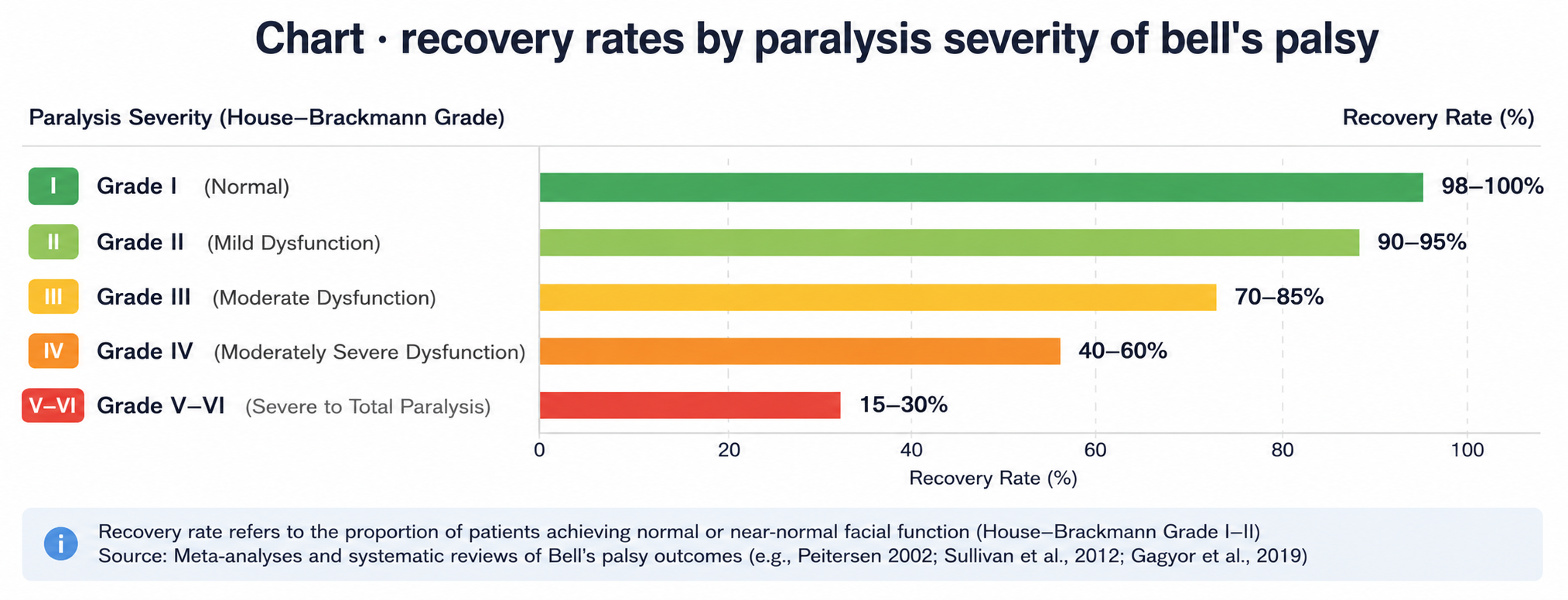
Your chances depend on how severe your facial weakness is:
Incomplete paralysis
Up to 94%
Recover completely
You can still move your face a little. Usually within 4 months.
Complete paralysis
About 70%
Recover completely within 6 months
You cannot move your face at all. Up to 30% may have some lasting weakness.
Warning signs that suggest a cause other than Bell's palsy
Tell your doctor right away if you have:
Weakness that developed slowly over days to weeks (rather than suddenly)
A rash, especially near your ear
No improvement after 3 months of treatment
Weakness on both sides of your face
Numbness or pain in your face
Excessive tearing from the affected eye
Hearing loss, ringing in your ears, or dizziness
A history of skin cancer or cancer of the salivary glands
Weakness in your arms or legs
Two sides of recovery

The Good News
Most patients recover
Most people with Bell's palsy recover completely within a few weeks to months, especially with early treatment. Even when facial palsy has another cause, many conditions are treatable once identified.
If you're in this group:
You'll start seeing movement return within 3-4 weeks
Gradual improvement over weeks/months
Eventually return to normal or near-normal
The Reality Check
~25-30% do NOT fully recover
Still have symptoms after 3-4 months
May develop synkinesis (abnormal movements)
May have permanent asymmetry
May have chronic tightness/discomfort
If no recovery by 3 months:
This is probably NOT Bell's palsy
Needs different diagnosis/treatment
Definitely needs specialist care
Critical Timeframes
0–72 hours
Immediate
Start medications (steroids, antivirals, calcium channel blockers)
Protect eye aggressively
See doctor for diagnosis
2 weeks
Specialist
See facial nerve specialist
May need EMG (nerve test)
3 weeks
Surgical window
Last chance for nerve decompression surgery (if greater than 90% nerve damage)
3–4 weeks
Early signs
If movement starting to return = good sign
90% chance of complete recovery
3 months
Decision point
If no improvement = unlikely to fully recover
Need specialized treatment (PT, possibly surgery)
May be developing synkinesis
6–12 months
Long-term